How YieldBasis Works
Impermanent loss, also called divergence loss, happens when the value of your LP position underperforms holding the assets you deposited. In an AMM like Uniswap V2, this can happen whenever the market price moves away from your entry price. The larger the price move, the more the value of the LP position can drift from holding the asset.
YieldBasis eliminates that impermanent loss by applying continuous 2× compounding leverage to a Curve Cryptoswap LP position. That yields a liquidity position that tracks the underlying asset, such as BTC or ETH, while still earning trading fees from the pool.
Deposit flow
You deposit one asset. YieldBasis borrows an equal value of crvUSD, deposits both assets into a Curve Cryptoswap pool, and keeps the LP tokens inside LEVAMM to maintain 2× leverage.
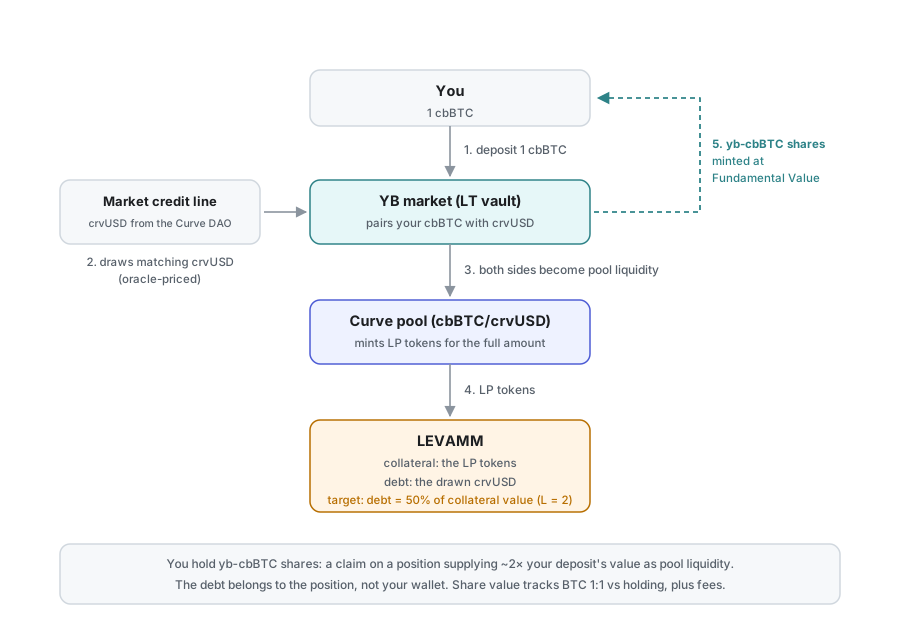
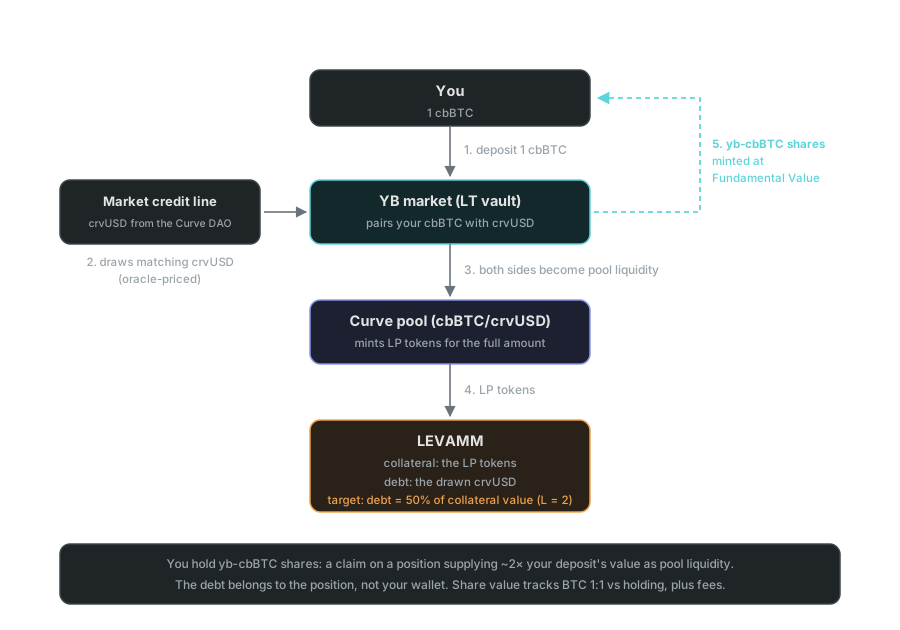
Walk-through
Consider 1 cbBTC and $100,000 of stablecoins at a BTC price of $100,000. Three strategies, fees aside:
- Hold both separately. Value moves linearly with BTC.
- Deposit both as a plain xy=k LP. Pool value grows as , sublinear in . Loses to the hold baseline whenever price moves.
- Deposit only the cbBTC into YieldBasis; keep the $100k as cash. YieldBasis wraps the cbBTC at 2× leverage; the wrapped value tracks BTC one-for-one. Cash stays at $100k.
| BTC move | Hold both | Plain LP (xy=k) | IL vs. hold | YieldBasis + cash |
|---|---|---|---|---|
| −50% (BTC = $50,000) | $150,000 | $141,421 | −5.72% | $150,000 + fees |
| 0% (BTC = $100,000) | $200,000 | $200,000 | 0% | $200,000 + fees |
| +50% (BTC = $150,000) | $250,000 | $244,949 | −2.02% | $250,000 + fees |
| +100% (BTC = $200,000) | $300,000 | $282,843 | −5.72% | $300,000 + fees |
The plain-LP shortfall always trails "just hold" as soon as BTC moves in either direction. YieldBasis recovers the baseline and keeps the trading fees the LP position earned.
YieldBasis vs a standard AMM (xy=k)
| Standard AMM LP (xy=k) | YieldBasis yb-LP | |
|---|---|---|
| Value scaling in volatile-asset price | (sublinear) | (linear) |
| Capital you commit | Both assets | Only the volatile asset (protocol borrows the stable) |
| Trading fees earned | Yes | Yes (same Cryptoswap pool) |
| IL exposure | Yes — symmetric drag in either direction | None, at the depositor level |
| Leverage | None (1×) | 2× compounding |
| Rebalancing | None; pool drifts as price moves | Via arbitrage against LEVAMM as leverage drifts |
The -to- shape transformation is the core mechanism. LEVAMM, VirtualPool, refueling, and the watermark exist to keep the 2× leverage exact and the position self-unwindable.
Why the leverage stays at 2×
A static 2× loan drifts the moment price moves. If BTC rises 10%, the collateral appreciates but the debt does not, and the leverage ratio falls below 2.
LEVAMM fixes this without keepers or scheduled transactions. LEVAMM quotes a price that matches the external oracle only when leverage is exactly 2. When leverage drifts, LEVAMM's quote drifts with it, and arbitrageurs profit by trading against the stale quote. Each arbitrage trade pushes leverage back toward 2. No user action is required.
What you hold
A deposit mints yb-LP shares: your claim on the leveraged position. Hold them unstaked to earn trading fees, or stake them in the gauge to earn YB emissions instead.
yb-LP Tokens covers share semantics and the staked-versus-unstaked split in full — the fee-flow diagram lives in Staked vs Unstaked Economics. Stake and Unstake yb-LP frames the decision.
Related
- Compounding Leverage: the math reason 2× works and how LEVAMM holds it there.
- yb-LP Tokens: share semantics and staked vs unstaked.
- Provide Liquidity: the first-deposit walkthrough.