Hybrid Vaults
Hybrid Vaults let you deposit BTC or ETH into YieldBasis beyond the standard per-pool cap, in exchange for keeping a proportional crvUSD deposit in scrvUSD on the side. You earn yield on both: scrvUSD's savings rate and the YieldBasis pool returns. The two positions stay separate: your crvUSD goes directly to scrvUSD and never touches the underlying BTC/crvUSD pool your LP position sits in.
The dual-yield model
| Position | Yield source |
|---|---|
| crvUSD backing | scrvUSD's savings yield (sourced from Curve's crvUSD mint-market borrow rate) |
| YieldBasis pool position | Trading fees (Fundamental Value growth) and optional YB emissions if staked |
The two yields accumulate separately. You can claim or withdraw from either side without disturbing the other. Each side is independently exposed to its own risks — the crvUSD side to scrvUSD's smart-contract risk and to the crvUSD peg, the LP side to YieldBasis's normal market and protocol risks. Your crvUSD has no exposure to the underlying BTC/crvUSD Curve pool.
Why Hybrid Vaults exist
The scaling problem
Standard YieldBasis pools fill within minutes of each cap raise: BTC exposure that earns trading fees without underperforming a plain hold is scarce. (The position still carries full BTC price exposure, down as well as up.) The reason for the cap is to maintain crvUSD peg stability. YB pools borrow crvUSD to create their leveraged positions, and large BTC or ETH price moves translate into outsized crvUSD-stable swaps inside the underlying Curve pools. Uncapped YB growth would pressure the peg.
Hybrid Vaults create direct demand for crvUSD (you either mint it or buy it), which supports the peg. In return, YieldBasis grants the LP a personal cap that lets them deposit into pools beyond the standard limit. Bigger backing → bigger personal cap → more peg support.
YieldBasis operates with a crvUSD credit line extended by Curve DAO, and Hybrid Vaults are one of the ways YB scales towards that credit-line ceiling while preserving crvUSD peg stability. The other scaling lever is the PID-based net-pressure incentive system (see Net Pressure & the PID Controller), which streams crvUSD incentives to a Curve sink pool whenever markets drift out of balance.
How it works
1. Create your Hybrid Vault
Each address gets one Hybrid Vault. At creation, you choose an ERC-4626 vault to hold your crvUSD backing. scrvUSD is the default; governance can allow-list other options.
2. Deposit crvUSD
The vault deposits your crvUSD into the chosen allow-listed ERC-4626 vault (e.g., scrvUSD), where it earns that vault's yield while sitting as backing.
3. Deposit into YB pools
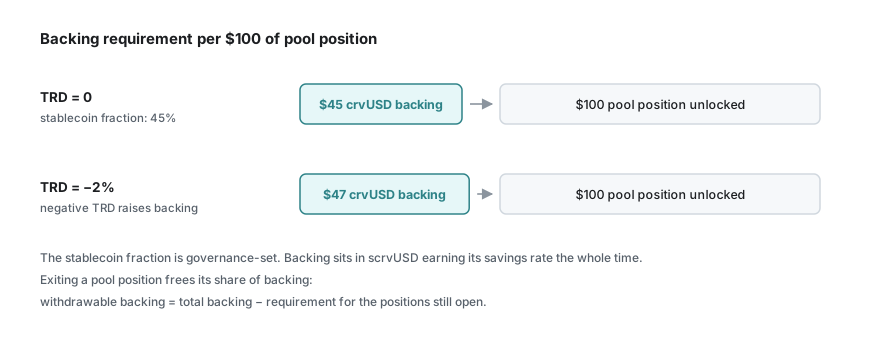
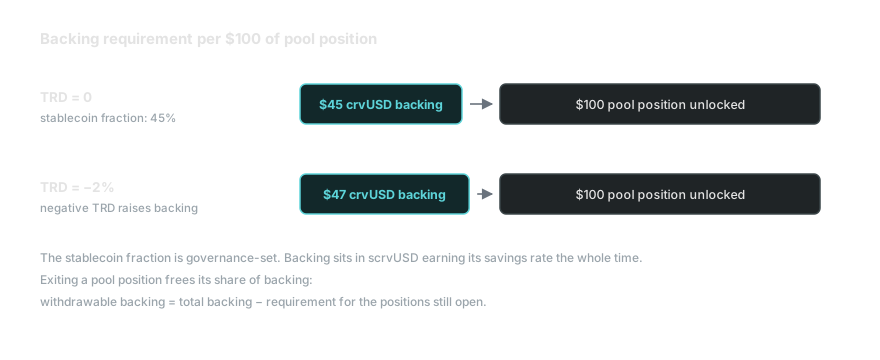
The crvUSD backing determines how much you can deposit into YB markets. The protocol enforces a stablecoin fraction (45% since the June 2026 DAO vote; governance-set, and higher in practice when pools are imbalanced): for every $100 of position value, you need $45 of crvUSD backing. You can split your capacity across multiple YB markets, up to 16 simultaneous positions.
4. Earn on both sides
The crvUSD deposited into scrvUSD (or whichever allow-listed ERC-4626 vault you selected) earns yield. The LP positions earn YieldBasis pool returns (Fundamental Value growth, or YB emissions if staked).
5. Withdraw in two stages
- From a YB pool. Withdraw your LP position first. If your remaining crvUSD backing exceeds what is required for the remaining positions, the excess becomes withdrawable.
- Fully exit a position. Frees the proportional crvUSD backing. Exiting every position frees all your crvUSD.
What you watch
The Hybrid Vault UI shows:
- Personal Capacity — total YB-pool deposit capacity unlocked by your current backing
- Deposit capacity — capacity remaining after current positions
- Available crvUSD — backing not yet committed to a position
- Total crvUSD Deposits / Total crvUSD Available — your overall backing and what you could withdraw
Plus the standard per-market data (Fundamental Value, Redemption Value, TRD)
Details
- Personal Caps are personal. Other users' deposits don't reduce your capacity, and yours doesn't reduce theirs.
- Hybrid Vault caps are separate from the standard per-pool caps. Both are DAO-governed and can be adjusted independently.
- No deposit or withdrawal fees at the Hybrid Vault layer. Standard YB pool fees still apply to the LP position itself.
- First market: WETH, with a $25M Hybrid Vault cap at launch. Additional assets follow.
- TRD applies the same way as it does for regular pool positions.
- Audited by ChainSecurity and MixBytes alongside the rest of the protocol. See Audits.
Example
Deposit $10,000 of crvUSD into a Hybrid Vault using scrvUSD as backing. At 45%, this unlocks roughly $10,000 / 0.45 ≈ $22,222 of LP capacity.
Split it: $11,111 into the cbBTC market and $11,111 into the WETH market.
Annual yield, fees aside:
- crvUSD backing: ~$450/year (at an illustrative 4.5% scrvUSD rate; the live rate moves with crvUSD markets)
- cbBTC pool position: tracks BTC + trading fees or YB emissions
- WETH pool position: tracks ETH + trading fees or YB emissions
The crvUSD yield is independent of the pool yields. Either side can be staked, paused, or withdrawn without affecting the other.
TRD-adjusted backing
When a pool's TRD is negative (Redemption Value below Fundamental Value), entering that pool requires more backing than the flat 45% would give. Example: at TRD = −2%, a $100 cbBTC position requires about $47 of backing instead of $45. This prevents under-backing of positions whose realisable exit value sits below their accounting value.
Changing your backing vault
You can switch the backing vault when no pool positions are open. Old vault shares are redeemed back to crvUSD and re-deposited into the new vault in one transaction. Only allow-listed ERC-4626 vaults are valid choices.
Emergency withdrawal
If a pool's oracle breaks or a position enters an abnormal state, the vault exposes a separate withdrawal path that doesn't depend on oracle health. It may return less than a normal withdrawal. Unstake first — staked positions need to be unstaked before this path can act on them.
Related
- Use Hybrid Vaults — step-by-step deposit walkthrough
- Fundamental Value, Redemption Value, and TRD — why TRD matters when withdrawing
- Audits — full audit history including the Hybrid Vault contracts
- Dev: HybridVault — contract reference
- Dev: HybridVaultFactory — vault creation and allow-list mechanics