Fundamental Value, Redemption Value, and TRD
A yb-LP share has two values: the value on the vault's books, and the amount that a withdrawal returns at this time. The gap between them is the Temporary Redemption Discount (TRD). TRD can stay open for weeks. If you withdraw while it is open, the discount becomes a realized loss.
The two values you see
| Value | What it is | Dashboard label | Source |
|---|---|---|---|
| Fundamental Value | The vault's accounting of per-share value, at the Curve pool's price_scale on the active markets. Exit slippage does not affect it. | Fundamental PPS | LT.pricePerShare() |
| Redemption Value | The amount you receive if you withdraw at this time. It reads live pool state. | Redemption PPS | LT.preview_withdraw(shares) |
The dashboard shows both at the same time. Fundamental Value grows from trading fees, favorable rebalances of LEVAMM (the market's leveraged AMM), and refueling subsidies. Redemption Value is what Cryptoswap and LEVAMM pay out for your withdrawal.
TRD formula
TRD is the signed gap between Redemption Value and Fundamental Value:
TRD is usually negative: Redemption Value is below Fundamental Value, and you give up that fraction of value if you exit at that time. Positive TRD is a small premium on exit, and it is not common. Zero TRD means that the pool and the vault are in balance. The dashboard shows Market TRD (pool-wide) and My TRD (your position). For each field, see Analytics.
Example
You hold 100 yb-LP shares in a cbBTC market after a sharp BTC move.
- Fundamental Value puts the position at 1.02 cbBTC.
- Redemption Value delivers 1.01796 cbBTC if you withdraw at this time.
- TRD = 1.01796 / 1.02 − 1 = −0.20%.
On a $100,000 cbBTC position, the vault's books show about $200 of value that a withdrawal in the same block does not deliver. If you withdraw before the gap closes, you receive $99,800, and the difference becomes a realized loss. Fundamental Value continues to accrue fees while the gap is open.
Why TRD appears
On the active markets, LT, the market's vault contract, values the position at the pool's price_scale, times the crvUSD/USD price. It does not use a live BTC or ETH price. Markets 0 to 2, which are deprecated, use the pool's price_oracle instead of price_scale.
Cryptoswap, the underlying pool, concentrates its liquidity around price_scale, its internal reference price. When the market moves, price_scale does not follow at once, and the pool's actual balances sit away from it. A withdrawal executes against those balances, so it returns less than the price_scale valuation. That difference is TRD.
price_scale moves only within these limits:
- A step limit. Each rebalance moves
price_scalepart of the way. Without a policy, a step covers one fifth of the gap, up to the pool's maximum step (the second value ofadjustment_step()). With the oracle-report policy, a step is half the gap to the target, at most the step cap in the policy'sconfig(). - A profit floor. The pool keeps a protected share of its lifetime profit. Governance sets this share per pool, and
reserved_profit_fraction()on the pool returns it. The pool recenters only if per-LP value stays above that floor. The rest of the profit is the rebalance budget: what the pool can spend on recentering without going below the floor. - One rebalance per block. Only the first pool operation in a block can rebalance, and only if it passes the profit floor.
A pool's policy contract can set the price_scale target and the swap fee, so it also affects how fast TRD narrows. The rebalance budget still pays for each step. See Pool policies.
How the gap closes
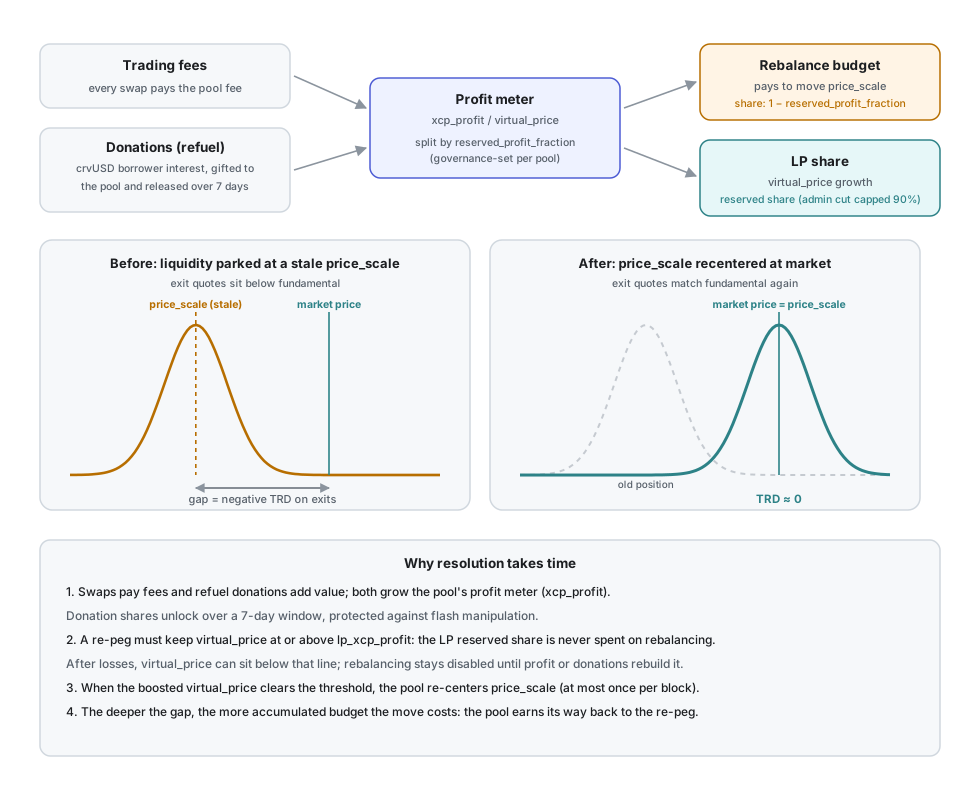
The gap narrows as Cryptoswap recenters, and each rebalance moves price_scale one step toward the market. It closes in two ways: Redemption Value rises, or Fundamental Value steps down when price_scale moves to the market. Part of a large gap can close by that step down. The gap also narrows if the market price returns to price_scale.
Recovery has no fixed duration. Besides the step limit, two conditions set how fast a gap closes:
- The price path. Two-sided trading earns fees and brings the market back toward
price_scale, so the gap closes faster. After a sustained move in one direction,price_scalemust travel far, and the gap can stay open for weeks. - The rebalance budget. Trading volume adds fees, and the budget grows. Each step spends profit above the floor. If the budget runs out before
price_scalearrives,price_scalestops until new fees and donations refill it.
To see how far price_scale is from recent pool prices, compare price_scale() with price_oracle(), the pool's own moving average of trade prices. On a pool with a policy, price_scale moves toward the policy target, which can differ from price_oracle.
When to act on TRD
- Withdrawals. Use Redemption Value to estimate what you receive. If Redemption PPS is below Fundamental PPS and the withdrawal is not urgent, check again later. Recovery can take weeks.
- Deposits. New shares mint at Fundamental Value, so TRD does not directly change your deposit. Hybrid Vault deposits need crvUSD backing equal to a set fraction of the position's Fundamental Value. See Hybrid Vaults.
- Staked positions. TRD applies to your withdrawal in the same way as for unstaked positions.
Other effects on what you receive
Two longer-term effects can also reduce what you receive. Neither is TRD.
PPS drag (unstaked). PPS (price per share) is the contract name for Fundamental Value. Over a holding period, cumulative rebalancing costs can be larger than fee income. Fundamental Value then grows more slowly, or decreases.
The drag is already in the reported PPS, so waiting does not reverse it. Fundamental Value climbs again when later fees are larger than later costs. For example, an unstaked LP holds through 30 days where rebalancing cost exceeds fee income by 0.6%, and Fundamental Value drops from 1.0000 to 0.9940. See What you pay.
Watermark shortfall (staked). The same 0.6% net loss for a staked LP shows as a price per share 0.6% below the high-water mark. LT charges no admin fee until gains repay the gap, and YB emissions continue to accrue. See Watermark and recovery.
Related
- Withdraw liquidity: how to use Redemption Value to estimate what an exit returns.
- Watermark and recovery: why a staked position can sit below its high-water mark.
- Pool policies: how the pool policy sets the swap fee and the
price_scaletarget. - yb-LP share value derivation: the math behind Fundamental Value and Redemption Value.