Staked vs Unstaked Economics
The staking decision is a trade.
The two positions
| Unstaked yb-LP | Staked yb-LP | |
|---|---|---|
| How you earn | PPS growth (fee-driven) | YB emissions only (pro-rata within gauge) |
| PPS growth claim | Yes | No — forfeited |
| Forms the protocol's "real yield" layer | Yes | No |
| Susceptible to watermark drawdown | No | Yes |
| Transferable | Yes (ERC-20) | Not while staked (transferred into gauge) |
Where the value goes
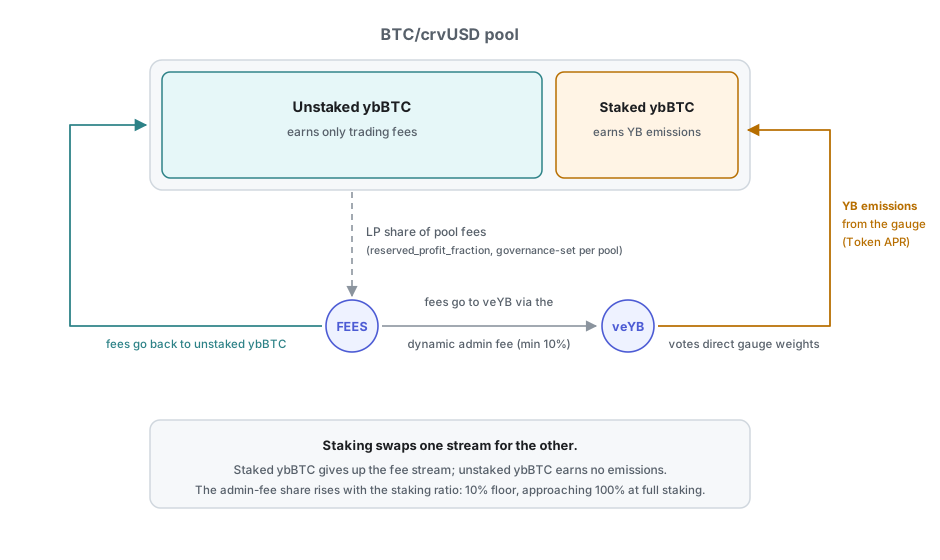
Fee flow from LEVAMM and the Cryptoswap pool reaches LT.vy, which splits each increment between the staked and unstaked sides. The split follows a square-root admin-fee curve in the staking ratio: the more LPs stake, the larger the share routed to veYB and the smaller the share kept by unstaked holders. Fees and veYB Revenue carries the formula and the full reference table.
As the staking ratio approaches 100%, the admin fee approaches 100% and unstaked returns diverge. The asymmetry is intentional, and it drives the self-balancing dynamic discussed below.
The watermark, in brief
The staked side carries a watermark: the high-water value it has previously reached. When rebalance slippage outruns fees the staked value drops, but the watermark holds. Future profits route to the staked side first, restoring it to the watermark before any further admin fee is charged. That is what makes a staked drawdown recoverable rather than permanent. Watermark and Recovery covers the full mechanism; Dev: LT has the on-chain names (staked, ideal_staked).
The worst-case scenario
The parameter set is tuned to avoid sustained negative APY; drawdown is treated as a parameter failure, not an expected outcome. The contract-level safety net protects you if the unusual sequence below does occur:
- Market conditions produce sustained rebalancing costs > fees (rare).
- Cumulative drag pulls
stakedbelowideal_staked. - You try to withdraw — your staked shares redeem for less than deposit, even with TRD = 0.
- YB emissions earned during the drawdown are your compensation for the wait.
- Parity returns when fees recover
stakedtoideal_staked.
The loss is recoverable: Recovery Mode routes all admin-fee flow to the staked side until parity is restored.
When to stake
- You want YB emissions (direct yield) and have conviction that YB price × your gauge's vote weight compensates for (a) forfeited PPS growth and (b) watermark-drawdown tail risk.
- You intend to hold long-term; you can wait out a drawdown.
- You want veYB voting power via eventual YB accumulation and lock.
When not to stake
- You want a passive, non-emission-exposed hold.
- You need to rebalance or exit on short notice.
- You want to avoid exposure to YB tokenomics.
Breakeven intuition
For a staked position to outperform an equivalent unstaked one over horizon :
Where YB_emissions_to_you = weekly_gauge_emission × (your_staked / total_staked_in_gauge) × YB/USD.
- Gauge emission depends on: total YB mint rate (function of
rate_factor), your gauge's vote weight, and itssqrt(staked/total_supply)adjustment. veYB voting influences the vote weight — it does not give you a per-user multiplier. - PPS growth forfeited is a near-deterministic yield you know you are giving up.
- Watermark drag is a tail: bounded, time-limited (recovers via admin-fee routing), but real.
Staking wins only when your personal emission share, priced at YB/USD, consistently beats the other two terms.
Admin-fee asymmetry
The admin-fee split is self-balancing. As the staking ratio rises, unstaked LPs keep a shrinking share of a shrinking fee total — but they are also an ever-smaller group, so per-LP returns can still diverge upward. That pulls LPs back toward unstaked when staking gets crowded, keeping the real-yield layer supplied. See Fees and veYB Revenue for the exact split at each staking ratio.
Related
- Fundamental Value, Redemption Value, and TRD: the two share values and the transient gap between them.
- Watermark and Recovery: the staked-side drawdown mechanism in full.
- Tokenomics: YB supply, emissions, and what drives Token APR.
- Stake yb-LP: how to move yb-LP into the gauge.
- Unstake yb-LP: how to exit the gauge.