Emission Dynamics
The emission rate adapts to gauge utilisation, defined as staked supply divided by total supply.
Emission rate formula
Over a time step , the protocol mints a quantity proportional to the remaining reserve:
The rate factor aggregates utilisation across all active gauges:
For each gauge , the adjusted weight scales the raw governance weight by the square root of that gauge's staking ratio:
Daily Emissions vs Staking Rate
How it works: As more ybBTC gets staked (stake_rate grows), daily emissions increase following the √s curve. This creates a natural balance where higher staking leads to higher emissions, but with diminishing returns.
The deployed numbers
- Emissions never fully end. Each period emits a fraction of whatever reserve remains, so the schedule tapers: meaningful emissions for many years, a long tail over decades, and no cut-off date.
- Emission reserve at deploy: 300,000,000 YB. The other 700M of the 1B cap was pre-allocated; see Tokenomics for the split.
- The decay constant corresponds to a 4-year e-folding time at full utilisation. If every gauge were fully staked the whole time, any 4-year window would emit about 63% of the reserve remaining at its start — leaving 37%, then 37% of that, and so on indefinitely.
- Real utilisation sits below 100%, so the actual taper is slower. The effective e-folding time is : at 25% aggregate utilisation, the same decay takes four times as long.
These are deploy-time parameters of the YB token contract, not governance dials: the reserve and max_mint_rate are fixed in the constructor. Governance influences emissions only through gauge weights and staking behaviour (the rate factor).
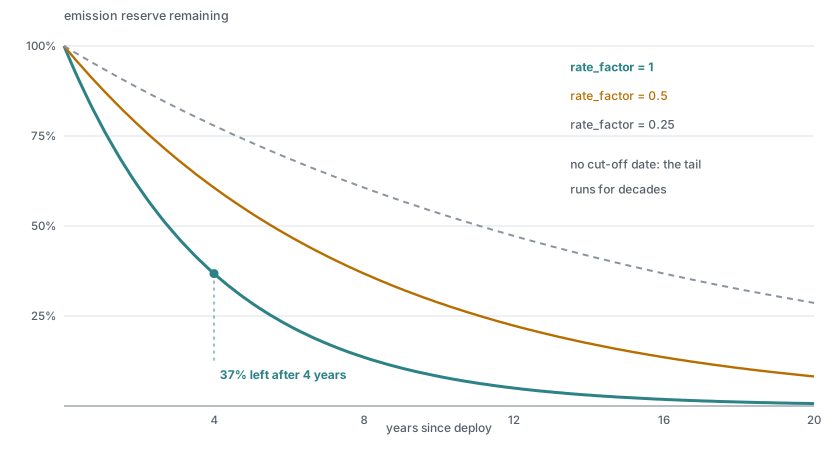
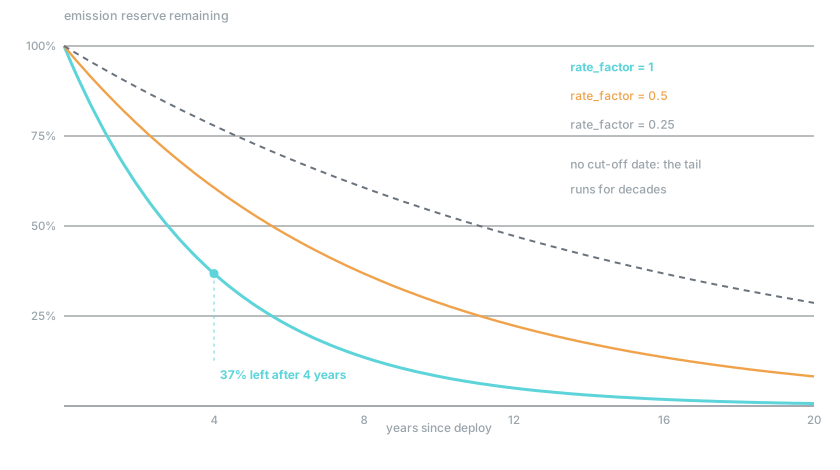
Reserve remaining over time. Lower gauge utilisation stretches the same decay; none of the curves ever reaches zero.
Behaviour at limits
When every gauge is fully staked, the rate factor approaches one and emissions run at the maximum decay rate fixed at deploy (max_mint_rate). When there are no stakers into the gauges, the rate factor approaches zero and emissions throttle proportionally. The emission reserve itself asymptotically approaches zero; there is no fixed end date, only a shrinking remainder. Total YB supply is still hard-capped at 1 billion: minted supply asymptotically approaches that cap and cannot exceed it.
Contrast with CRV
For readers familiar with Curve's CRV schedule, the structural differences are:
| CRV | YB | |
|---|---|---|
| Schedule | Piecewise: multiplied by each year | Continuous exponential decay |
| Adaptation | Static | Gauge-utilisation-driven |
| End state | Asymptotic total supply approximately 3.03 billion CRV | 1 billion YB hard cap; emission reserve approaches zero |
Related
- Tokenomics — veYB, yb-LP, and how emissions enter the token flow.
- Gauges & Emissions — the governance-side view of gauge weighting.
- Dev: YB Token — on-chain token contract.
- Dev: GaugeController — gauge weight registry and voting.